

For the people who set Canada's cap, and the provinces who divide it: a student who arrives already housed isn't the problem the cap was built to solve.
A disclosure before I make the case: my firm builds and operates student housing, so I have a direct stake in where this issue lands. Read it with that in mind. I still think it holds.
Strip the language back, and Canada's student cap is a housing policy. Ottawa has said so from the start: it's there to relieve pressure on housing and the public services that strain alongside it. And the numbers keep coming down. For 2026, 408,000 study permits nationally, down 7 percent on the year before. Ontario's allocation alone declined by 42 percent.
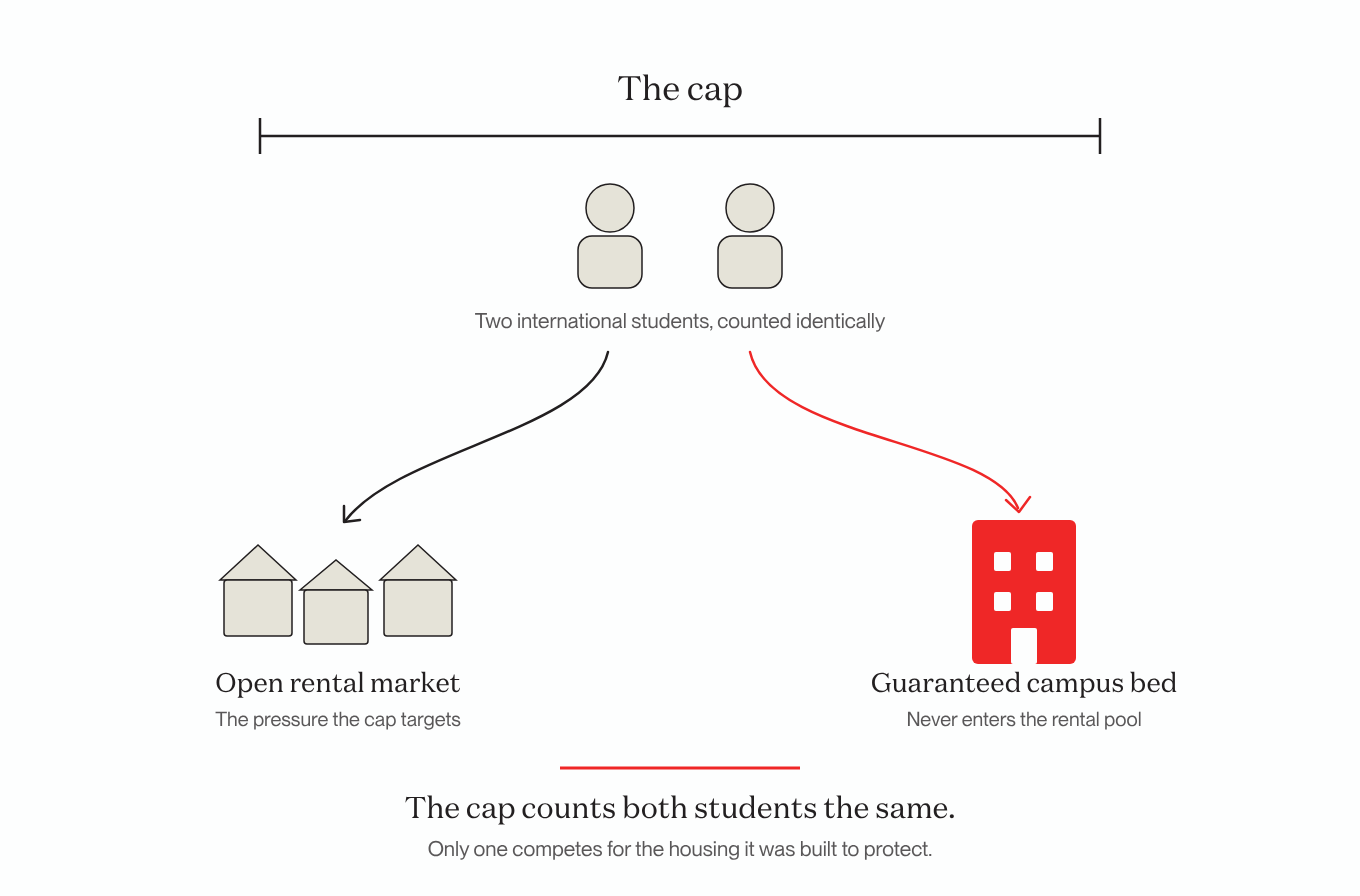
The logic is that every international student who lands here competes for housing locals need too. For someone renting on the open market, fair enough; that's roughly what happens. But it falls apart for one group: students whose school guarantees them a purpose-built bed for their entire program. They never enter the local rental market at all. They're housed from first year through to their last, in buildings put up for them, not in housing pulled away from anyone else. Whatever the cap is there to prevent, it isn't happening with them.
So why does the framework count a housed student the same as an unhoused one?
The gap is real, and it has a fix a peer country is already running.
What the rules actually say
I went through them to see whether the answer was already sitting there somewhere. It isn't. Federally, the cap runs on Ministerial Instructions, and each province's share is calculated from population and past approval rates. Housing plays no part in that math, and it is not one of the exemptions either; those cover graduate students at public institutions, K–12 pupils and a few other groups, not anyone who arrives with secured accommodation. The federal rationale points only to nationwide pressure on housing and services, never to whether a given school has housed the students it admits. Nothing in it rewards a school for easing the very pressure the cap invokes.
The provinces have more room to move, because they decide how their own allocation gets divided, and they're free to weigh housing if they choose. So far, none has made it a stated criterion. Ontario, the largest market, parcels out permits by labour-market fit, favouring programs tied to in-demand sectors like health care, the skilled trades and technology, with publicly assisted colleges and universities taking 96 percent of the allocation. Housing never enters it. So the lever already sits one level below Ottawa, and no province has reached for it.
How Australia solved it
The Australians built exactly this. Their system runs off a National Planning Level of 295,000 places for 2026, and public universities can apply to grow beyond their baseline by delivering on government priorities, one of which is secure housing for both domestic and international students. It has moved real supply: on the government's own numbers, roughly 11,000 beds are under construction, another 15,000 have development approvals, and 12,000 more are in planning, and 31 of the 32 universities that sought growth got it. They capped, but they left the door open.
What a Canadian version would take
It wouldn't need to be generous, only specific: extra permit room, above the baseline, for schools that guarantee dedicated housing for the students those permits let in, and that stand behind more than the bed itself. If you're going to earn enrolment from your housing, you ought to be accountable for what that housing is supposed to deliver, which is students who settle in and complete their studies. A residence a school runs with its operating partner can support that. A handful of scattered rental rooms can't.
I won't pretend it's straightforward. Three things have to work, and the first is why schools can't afford to wait. Anyone who has taken a residence from a bare site to move-in day knows it runs in years, not months: land, approvals, a financing package, a builder, then construction. In Australia the industry pegged it at up to three years just to get a project approved and into the ground, and that's before a single bed opens. Permit allocations, meanwhile, reset every year. Nobody finances a thirty-year building against a one-year policy. So schools have to start now, and the pathway itself has to be built to last, running several years and grounded in rules rather than a minister's discretion. Australia's own sector raised the obvious risk: when the rule behind the beds can shift each year, the case for starting a build weakens. A one-year incentive would do more harm than leaving things alone, pulling long-dated money toward a promise the policy can't keep.
Capital won't chase a promise that expires every December.
The second is proof, and the government is right to insist on it. A bed should only count if it genuinely adds supply; a conversion of existing housing just relabels a unit a family might otherwise have taken. Duration matters as much. Most Canadian universities guarantee first year only, and none are obliged to — though a few, McMaster, Laurier and Guelph among them, already guarantee international undergraduates a place for their whole degree, and some U.S. colleges require on-campus living outright. A first-year promise still sends the later years back into the local market, the displacement the cap invokes, so the guarantee worth rewarding is one that lasts as long as the student is enrolled. It also can't quietly push a domestic student into the market the cap is trying to shield. Verifying all that takes machinery nobody has built yet: bed-to-enrolment ratios, tenure commitments, an outside audit.
The third is that responsibility here is shared three ways. Immigration is federal, the school-by-school allocation is provincial, and housing approvals sit with provinces and cities. A province could start weighting housing tomorrow, but doing it inside a fixed allocation only moves permits from one campus to another; it doesn't add to the total. More capacity appears only if Ottawa agrees to let housed beds sit above the cap, the way Australia's above-baseline places do. The workable route is to run both tracks at once: let a province prove the idea within its current numbers while the federal case gets made for room on top.
Reward the schools that show up with the problem already solved.
None of this is a plea for more students in the abstract. The housing crunch behind the cap is real, and I'm not disputing it. The point is narrower: a cap built to protect housing ought to distinguish the student who adds to the pressure from the one whose school has already handled it, for the student and the city alike, and give schools a reason to build toward the second kind. There's a bigger prize in it than tidy housing policy. Universities are being told to shed the international enrolment their budgets now lean on, with no public money replacing it, and a verifiable housing guarantee is the one lever that lets a housed cohort back without reopening the pressure the cap was built to relieve. The ask isn't more students; it's more guarantees, and a cap smart enough to reward them. The pieces already exist, and other countries have shown they fit together. So far nobody here has bothered to put them in the same room.
Sources: IRCC 2026 Ministerial Instructions and the federal 2026 provincial/territorial allocation notice (Canada.ca); Government of Ontario 2026 PAL allocation release; Australian Department of Education 2026 allocation statement (Minister Clare, 14 October 2025) and related coverage.